
Key Takeaways
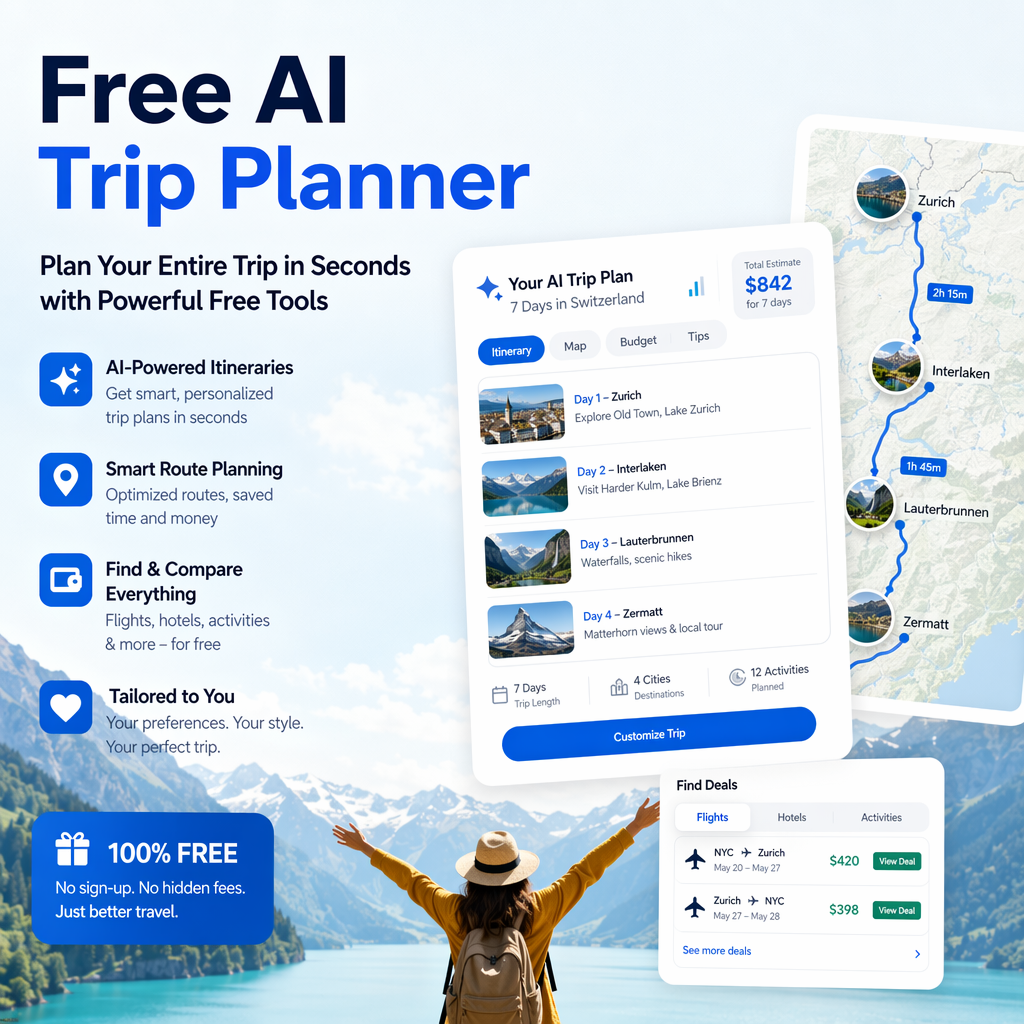
- Our free AI tools craft complete, day-by-day itineraries in seconds based on your preferences, dates, and destinations by comparing thousands of flights, hotels, and activities for your best match.
- Custom suggestions adjust to your preferences and input, providing eateries, attractions, and substitutes with local expertise and popular picks.
- Real-time updates keep plans fresh in response to delays, weather, and events, alerting you to disruptions and proposing backup options that integrate with live maps and transit schedules.
- Budget optimization features calculate your estimated total, suggest less expensive alternatives, track your expenses live and display easy-to-digest breakdowns to keep you on budget.
- Seamless integrations import bookings, sync with calendars and devices, connect to ride-share and translation apps, and facilitate collaborative editing and sharing with travel companions.
- As you select a planner, prioritize travel style support, customization controls, and strong data privacy practices. Look for ways to couple AI efficiency with human expertise for deeper, more genuine travel experiences.
Free AI tools that plan your entire trip in seconds. Free AI trip planners are online services that create travel itineraries, cost estimations, and even book accommodations based on user input. These free tools combine map data, flight and hotel listings, and local attractions information to output day-by-day plans and cost projections. Most provide selections for budget, speed, and likes. Some connect with calendars or export files for convenient distribution.
Accuracy depends on source data and availability, so major reservations should be cross-checked. For travel-starved, time-squeezed people, these tools reduce planning hours into minutes and allow you to quickly put various routes and prices side by side. The main body below reviews top services, explains how they work, and shows practical tips for reliable results.
How AI Tools Plan Your Trip


AI tools first convert user inputs, such as preferences, travel dates, group size, and budget, into an actionable representation of the trip. They plot priorities such as chill versus sightseeing, food restrictions, and mobility constraints.
It then cross-checks these against destination information, average weather, event lists, and transportation schedules to create a customized itinerary in seconds. For easy weekend getaways or one-way flights, this functions great. For complicated group planning from multiple departure cities, the tool will require manual interventions.
1. Instant Itineraries
AI can produce a day-by-day itinerary as soon as you input some basic information. It displays bookings, top attractions, and transit all in one view so you don’t bounce between tabs. Most tools present this in human-readable lists or tables and provide drag-and-drop editing to easily reorder activities. They might add notes like early check-in compatibility or overnight layover avoidance.
Others spit out downloadable plans for offline consumption. Some might generate interactive city grids with timed blocks that correspond to opening hours and travel time estimates.
2. Personalized Suggestions
Recommendations are based on declared interests and travel history. If you’re a museum and local food fan, it’ll throw out a schedule filled with galleries, local cafés and late-afternoon markets. As you provide suggestions, they evolve. You can trade a gourmet restaurant for a street-food vendor, include kid-friendly stops, or recommend off-peak times at tourist hotspots.
Typically, they provide options for every activity to suit different moods or group members. They gather local knowledge and hot spots, but others target general city information and may overlook detailed logistics.
3. Real-Time Adjustments
When flights delay or an attraction closes, AI updates itineraries and suggests backups. Notifications pop up on mobile, and plans integrate with live maps and transport schedules for timing. Users can adjust plans on the fly from any device, and the tool will re-time connections and rebook where possible.
You can synchronize for a group of travelers, though it won’t always honor everyone’s preferences.
4. Budget Optimization
These tools calculate all your costs up front and offer swaps to help you stay within budget. They suggest less expensive hotels, alternate transportation, or more affordable meals and they can monitor spending live. Clear breakdowns in tables or charts help plan spending, but multi-city routing may not be cost-optimal without user oversight.
5. Seamless Integration
Trip plans can sync with calendars, pull in bookings from wherever you make them, and connect to ride-share, navigation, and translation apps. Sharing and collaboration features allow companions to see and modify the itinerary, enhancing coordination. Exotic group travel still occasionally needs manual adjustments.
The Technology Behind The Magic
Our AI travel planners use a few core technologies to transform raw travel information into actionable itineraries in seconds. Machine learning trains models on previous trips, price histories, and user behavior for the system to map preferences to options. Natural language processing allows users to type or speak requests and get back clear, structured plans.
These tools operate on cloud infrastructure that scales to handle massive datasets quickly and connect to third-party services via APIs to retrieve real-time data like flights, hotel availability, weather, and events.
Data Sources
Aggregated feeds from airlines, hotel chains, tour operators, and local guides power the recommendations. Real-time streams provide weather, event listings, and traffic updates so itineraries adjust to shifting conditions.
User reviews and ratings provide qualitative context, assisting systems to balance local advice with official listings. All incoming data is normalized into structured formats, such as JSON or CSV, so ML models and front-end displays can read and compare entries quickly.
Learning Algorithms
Models monitor specific decisions and detect repeated preferences or aversions. They modify recommendations accordingly to fit user taste.
Systems optimize selection by referencing previous trips against new inputs and providing increasingly more relevant matches.
Algorithms mine worldwide booking and search data to identify emerging destinations and changes in seasonality.
Self-learning loops conduct A/B tests and feedback cycles, pruning mistakes and increasing relevance at every pass.
Predictive Analytics
Forecasts demand for flights, hotels, and attractions, helping users choose the best times to book. Models digest price histories and supply signals to alert of probable spikes or dips, seeking to snag lower prices.
We use predictive tools that estimate crowd sizes and wait times at sites so plans dodge peak congestion and construct smoother days. When demand or prices spike, systems recommend off-peak options that typically save money and improve comfort.
AI trip planners can piece together near-expert quality itineraries in seconds, achieving up to about 80% of expert quality. A few newer tools now claim 98% accuracy while curbing hallucinations. They automate budget breakdowns, activity suggestions, and bookings, and can save users hours.
One report cited 90 minutes compared to weeks of manual work. Things that are updated in real-time, you should still always check crucial info on official sites.
Benefits Beyond Speed
AI trip planners don’t just spit out an itinerary fast. They enhance the entire travel experience by reducing cognitive overhead, increasing confidence in decisions, and simplifying trips. These tools do more than just speed; they transform fragmented search results into organized, actionable plans. They reveal where time and money are being spent, allowing users to optimize.
Discovery
- Curated recommendations for peaceful streets, offbeat museums, and street food vendors tailored to previous trips and interests.
- Day Trips & Byways recommendations for day trips and scenic routes that fit a traveler’s pace and mobility.
- Lists that steer users from packed attractions to hidden jewels or local seasonal happenings.
- Tips for secret cafés, markets, and pop-ups you wouldn’t discover with a basic search.
Drawing from sources including reviews, social trends and local calendars, AI recommends new venues. A user into coastal walks could be presented with a cozy little coastal village, alongside a local fish market and a short ferry route. This can give rise to possibilities that work within culture, budget and timing constraints.
Efficiency
Skip hours of manual research and compare options fast. AI bundles flights, trains, and accommodations, then displays a graphic cost split so users know exactly where their budget is going. That allows groups to share expenses or reschedule to save money.
Confirmations, reminders, and schedule updates – automate them. A few will rework your plans if rain is predicted or alert you to earlier trains. Centralize reservations, maps, and tickets in one view, so you’re not hunting through apps and emails.
Simplify communication with hotels, hosts and transport providers via templated messages or direct links. Other benefits beyond speed include users reporting complete itineraries made in 15 to 20 minutes and savings of $200 underspend in one case when the planner uncovers lower fares or cheap substitutes.
Collaboration
Let lots of people contribute to a shared plan and contribute ideas. Voting capabilities settle disputes and bring forth favorites without extended conversations.
Sync updates across phones and tablets so everyone notices changes simultaneously. Tag activities such as ‘book dinner’ or ‘reserve museum tickets’ and easily split up expenses using integrated tools to track payments.
Packing lists or infant-care notes can be sparked by the trip, and timing can be mapped so transit connections and daily activities fit. It makes group or solo trips simpler, safer, and more accommodating to varying travel styles.
The Human Touch vs. AI

AI can construct an entire trip within seconds and economize. They grab schedules, rates, and paths from a system of sources swiftly. Human planners still contribute judgment, taste, and long-term knowledge that machines don’t have. AI itineraries are, on average, 85% accurate, but one in six suggestions can be off. That’s the gap where human expertise is most relevant.
Spontaneity
AI can make last-minute changes, rebooking routes or seeking out nearby options on the fly. A few other apps share live events, transport updates and hotel vacancies so you can shift plans without a mad dash. They propose instant local attractions when plans change, which encourages real-time, authentic detouring.
AI leans toward declivities of choice, so leave white space in any prompted schedule. Use an AI plan as a scaffold. Reserve a couple of hours here and there for wandering, discover one or two ‘no-plan’ windows, and watch your day emerge.
Flexible tools work best when paired with simple rules: pick one unplanned morning per destination and use the AI’s quick search to fill it if you want. That balance maintains a plan-on-a-base while preserving space for surprise.
Hidden Gems
AI scours reviews, social posts, and niche blogs to highlight off-the-beaten-path places overlooked by guidebooks. It could identify popular cafes, street markets, or viewpoints and refresh recommendations according to recent user ratings.
These selections can still sound bland or automated. A human researcher or local guide can vet those options, add context, and highlight what makes a place feel special, its history, its owner, a quirky custom.
Curated lists are effective if AI generates the initial pass and a human edits it. Let AI collect candidates and a local or savvy traveler validate which they actually deserve to visit.
Personal Connection
AI can direct local tours, community events, and meetup groups that provide actual physical touch. It can align activities to expressed values, such as eco-tours, culinary workshops, or volunteer days, and recommend ways to connect with locals.
AI is usually voiceless, and advice can come off dull. Human planners bring nuance, suggest how to act politely, and propose talking points. Blend both: use AI for logistics and a human touch for cultural framing and etiquette tips that lead to genuine interactions.
Choosing Your AI Travel Planner
Selecting your AI travel planner Here’s what to consider: tool accuracy, customization, privacy, output layout and booking support before committing.
- Key factors to consider:* Travel-style support: adventure, relaxation, family, solo.
- Customization depth: manual edits, special needs, dietary filters.
- Group handling: multi-departure, shared itineraries.
- Output clarity: two-column summaries, printable PDFs, mobile view.
- Optionality: multiple activity and dining suggestions.
- Cost features: live cost estimates, budget totals, currency support.
- Booking links: direct booking, vendor details, reliability.
- Data privacy: data minimization, anonymous mode, clear policy.
- Extra tools: packing lists, local tips, nap-time scheduling.
Travel Style
Match the planner to your type of trip. Some tools classify activities by style. Others throw it all in together. If you seek adventure with hiking and local guides, select a planner that sorts for outdoor and active experiences and displays difficulty and mileage. For family trips, look for child-friendly filters and the capacity to schedule nap times and downtime. One of our tested planners tackled infant nap scheduling like a champ. Solo travelers often desire safety notices and social gatherings. Make sure those filters are present.
A lot of planners provide hard day-to-day schedules as well as loose suggestions. Choose based on your pace: strict hour-by-hour plans or flexible blocks. Certain tools offer a few dinner suggestions each night, while others just give you one. Seek out tools that allow you to pivot back and forth between structured and spontaneous modes.
Customization Needs
Evaluate how much you can alter. Leading free options allow you to tweak times, trade out activities, and insert your own stops. Others even take it a step further and customize suggestions based on dietary restrictions or accessibility needs. When we tried a complicated multi-person request, most of the tools faltered. One shined, but even it had its limitations in multi-city group coordination.
If you require serious personalization, select tools that persist preferences, push notifications, and manual override. See if it supports adding custom notes, booking references, or unusual items like guided-tour codes. Check if packing lists and booking tips are customizable.
Data Privacy
Check privacy policies and data controls. Prefer planners with anonymous planning modes, minimal data collection and the ability to delete trip data. Check if the app shares details with partners and if storage is encrypted. Some of the free planners want only minimal info and will still provide some solid itineraries, while others need more access to optimize personalization. Opt for openness and control.
The Future of AI Travel
AI travel planning tools already slash planning time from weeks down to as little as 30 minutes, and the next wave will take that even further while transforming how travelers engage with trip planning. Anticipate voice-first assistants that accept natural speech and parse date, budget, and style of travel to generate an entire plan in less than 60 seconds.
For example, a traveler requests “a five-day cultural trip to Lisbon, €1,200 budget, relaxed pace” and the assistant outputs flights, a day-by-day schedule, cost breakdowns for accommodation, food, activities, and transport, and calendar events primed to sync. AR will superimpose live previews over actual locations, so you’ll point your phone at a plaza and see recommended paths, operating hours, and local points of interest in advance.
End-to-end trip management automation manages bookings, changes and on-trip updates with little input. After initial preferences, they’ll book refundable options within budget, monitor for price drops, and rebook when it’s financially smart to do so. Common functionality such as group budget tracking, activity voting, and conflict resolution will allow groups to coordinate, all without message chains.
A group votes between a cooking class or a boat tour, and AI counts votes, re-tallies prices, and updates a new itinerary and payment links. Realistic timing in itineraries will incorporate travel times, buffer windows, and local transit schedules so plans feel practical, not just aspirational.
Smarter personalization will emerge from wider and deeper travel data. They’ll learn from past trips, reviews, and seasonality to suggest activities that fit tired energy levels, mobility, or dietary requirements. If a traveler frequently enjoys late mornings and museum visits, the AI will move mornings open and schedule afternoon admissions.
Yet users must verify details. Current estimates suggest AI tools give inaccurate information about one in six outputs, so double-check reservations, opening hours, and visa rules before travel. Travelers need to customize AI plans for safety and taste, modifying pacing or exchanging recommended hotels.
AI can make global travel more accessible by reducing planning friction and standardizing costs in a single currency, allowing budget travelers to easily compare. Equipped with transparent cost breakdowns and calendar sync, planning turns into a communal, frictionless activity that anyone can handle.
Conclusion
AI travel planners reduce planning time and automate the small stuff. They compare prices, coordinate flights and trains, arrange itineraries, and identify visa or vaccine requirements. Pick a tool that matches your style: budget, comfort, or adventure. Use recent reviews and try it out on a short trip first.
Keep your sense in the game. AI is quick to discover options. You verify specifics, instinct suitability, and security. Blend AI output with local advice, maps, and live bookings for hard legs. More accuracy will come as models learn from live data and user fixes.
Sample one free tool on a short trip this month. Watch how it maps times, costs, and sights. Make a decision from there.
Frequently Asked Questions
How accurate are free AI trip planners?
Accurate for simple itineraries, timings, and recommendations. Accuracy depends on data sources and updates. Check essential info such as transport times, visa regulations, and opening times prior to booking.
Can free AI plan complex multi-destination trips?
Yes. Several free tools support multi-stop routes and optimize travel time. For complicated needs, such as custom visas, business travel, and special accessibility, confirm plans with a live expert.
Are free AI travel planners safe with my personal data?
Safety would rely on the tool’s privacy policy and security measures. Use reputable services, review data-sharing policies, and don’t post sensitive documents unless the site has robust encryption.
Will AI find the cheapest flights and hotels?
AI can rapidly sift through a lot of options and emphasize discounts. It probably won’t tap into all discounts or private rates. Double-check with airline and hotel sites and loyalty programs.
Can AI handle real-time changes during a trip?
Certain AI tools can provide live updates and rebooking recommendations. Free versions may have limited real-time support. Have backup plans and providers’ contact info on hand for delays.
How do I choose the right AI travel planner?
Choose tools that have current information, transparent policies on data usage, and good reviews. Look for features you need such as multi-stop planning, local recommendations, language support, and real-time alerts.
Will AI replace travel agents?
AI simplifies planning and gives you back time. It wouldn’t completely replace agents for complicated, high-touch trips or personalized service. Use AI for speed and use agents for knowledge when necessary.